💖 copper peptide for hair loss · what nobody on r/tressless is saying 💖
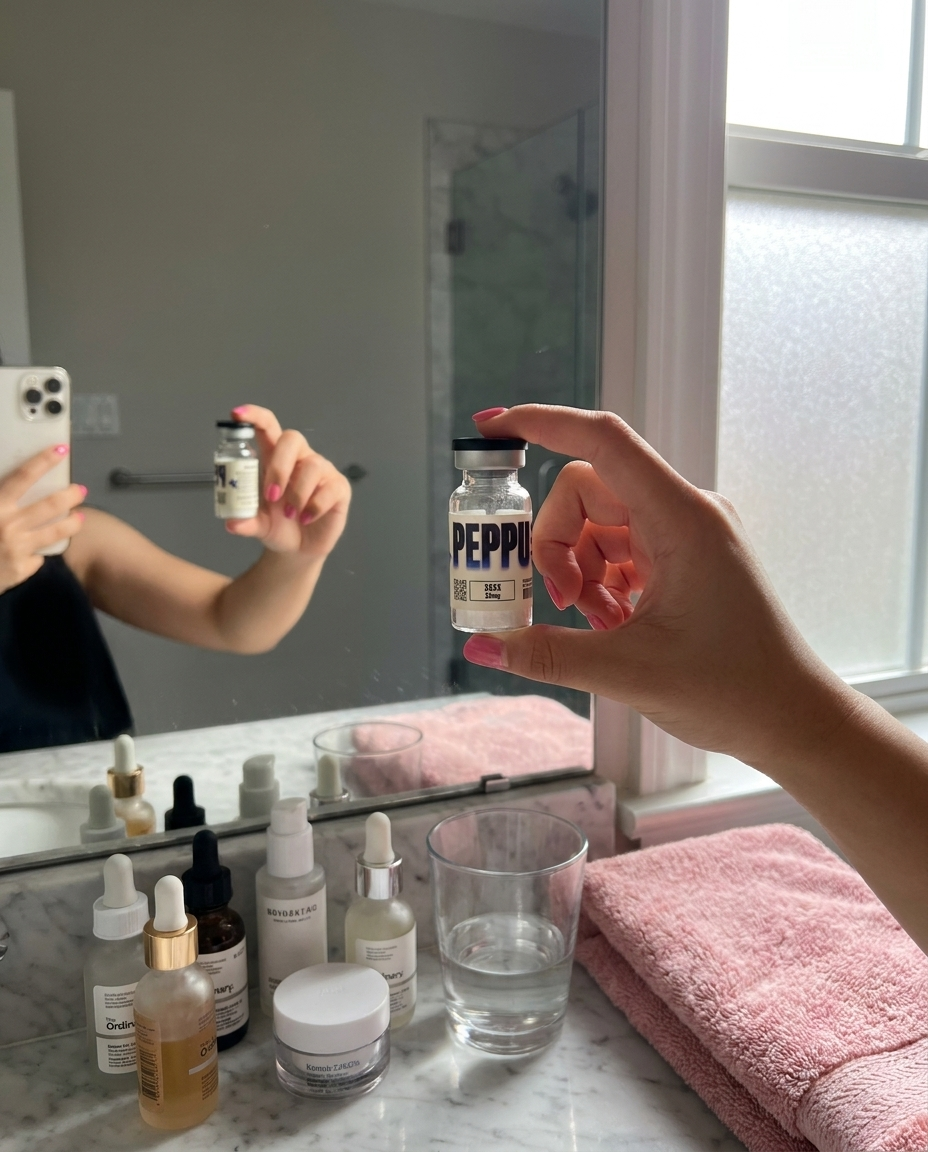
this one is for the girlies asking why my hairline grew back. and also for the boys lurking r/tressless · u're welcome 💀
so: GHK-Cu (the copper tripeptide) is the reason my temples filled back in over 16 weeks. minoxidil did some of the work too, but i wanna talk about the copper-peptide part because nobody talks about it
the rodent data is what got me · GHK-Cu enlarges hair follicles in mice and prolongs the anagen (growth) phase. it ALSO downregulates 5α-reductase mRNA in cultured dermal papilla cells, which is the same enzyme finasteride blocks but at a different layer. peer-review papers on follicle biology have this in print
no clinical RCT with GHK-Cu as the sole intervention for human androgenic alopecia exists. that's the honest answer. but there ARE rodent studies, follicle in-vitro work, and a body of community-reported success stories. the FDA doesn't approve copper peptides for hair loss because nobody's funded the trial
my protocol: GHK-Cu reconstituted to 1% topical solution, applied to the scalp 5 nights a week before bed. plus i kept minoxidil 5% (the foam, twice a day). that's it. nothing fancy
what i noticed timeline-wise · weeks 1-4 nothing visible but my scalp felt less itchy. weeks 4-8 baby hairs at the hairline (you can see them under bathroom light, look like little pixels). weeks 8-12 the baby hairs thickened and grew through. weeks 12-16 actual filled-in hairline, real length
the deal with copper peptide + minoxidil stacking: they don't conflict. minoxidil opens the K+ channels and drives the vasodilation. GHK-Cu drives the matrix-remodeling and follicle-size piece. different mechanisms
side effects: literally none for me on the topical route. some people report a slight greenish-blue copper stain on the towel after washing - that's just the Cu²⁺ binding to keratin temporarily. doesn't dye your hair
the peppudex card · https://peppudex.com/ghk-cu · has the full mechanism with evidence grades. the wiki version at https://wiki.peppu.studio/wiki/GHK-Cu has the citations. and the vial is at https://peppu.studio
honest disclosure: this is a research compound. the FDA hasn't approved GHK-Cu for hair loss. peppu sells it for laboratory research use
if u're a girl who's losing hairline from being on T or off-cycle birth control or just life · talk to a derm AND read the mechanism literature. don't just trust me. but the copper peptide route is real and it's cheap 🎀
✨ FAQ · what babes always ask
💖 Does copper peptide actually grow hair?
GHK-Cu enlarges hair follicles and prolongs the anagen phase in rodent models. It also downregulates 5α-reductase mRNA in cultured dermal papilla cells. Human RCT-grade evidence with GHK-Cu as the sole intervention does not exist as of 2026; community-reported topical research protocols are extensive but anecdotal.
💖 Copper peptide vs minoxidil - which is better?
They work through different mechanisms and are typically combined rather than chosen between. Minoxidil opens K+ channels and drives vasodilation. GHK-Cu drives matrix remodeling and follicle-size enlargement. Most community protocols stack both.
💖 How long does copper peptide take to grow hair?
Baby hairs at the hairline typically appear 4-8 weeks into consistent topical research use. Thickening through to visible filled-in length is reported around 12-16 weeks. Individual response varies.
💖 Can I put GHK-Cu directly on my scalp?
Topical GHK-Cu at 0.05-1% is the standard research route. Most users reconstitute the lyophilized peptide in saline or sterile water and apply via a dropper to the affected scalp area on dry skin before bed.
💖 Will copper peptide stain my pillow?
GHK-Cu binds keratin temporarily and can leave a faint blue-cyan tint on a white pillowcase after extended contact. It washes out completely. It does not permanently dye hair.
💖 Is copper peptide better than finasteride?
Finasteride is a systemic 5α-reductase inhibitor with FDA approval. GHK-Cu is a topical copper-tripeptide with no FDA approval for hair loss. The mechanisms partially overlap but the evidence bases are completely different in quality.
💖 Can women use copper peptide for hair loss?
Topical GHK-Cu is generally well-tolerated regardless of sex. Female-pattern hair loss research has documented less robust response to minoxidil than male-pattern, and the GHK-Cu add-on is a common community-reported strategy.
💖 Does GHK-Cu help eyebrows and eyelashes?
Anecdotal community reports describe eyebrow density improvements with low-concentration topical GHK-Cu. Eyelashes are higher-risk for direct application due to eye exposure and are not a routinely-studied application.